


Tag Archives: MariaDB Releases

We are pleased to announce the availability of a preview of the MariaDB 12.2 series. MariaDB 12.2 will be a rolling release.
MariaDB 12.2 introduces numerous new features, in particular
Compatibility features
- TO_NUMBER() function (MDEV-20022)
- TRUNC() function (MDEV-20023)
- Global Temporary Tables (MDEV-35915)
- Optimizer hints: [NO_]ROWID_FILTER (MDEV-36089)
- Optimizer hints: [NO_]INDEX_MERGE (MDEV-36125)
- INFORMATION_SCHEMA table TRIGGERED_UPDATE_COLUMNS (MDEV-36996)
- Optimizer hints support for named query blocks and views (MDEV-37511)
Miscellaneous
- INFORMATION_SCHEMA table PARAMETERS has a new column PARAMETER_DEFAULT (MDEV-37054)
- Improved support of replication between tables of different structure (MDEV-36290)
Thanks, and enjoy MariaDB!
…
We are pleased to announce the availability of a preview of the MariaDB 12.1 series. MariaDB 12.1 will be a rolling release.
MariaDB 12.1 introduces numerous new features, in particular
Performance improvements
- Segmented key cache for Aria (MDEV-24)
- MDL scalability improvements (MDEV-19749)
- Parallel replication for galera replicas (MDEV-20065)
- Buffered logging for audit plugin (MDEV-34680)
- Faster vector distance calculations via extrapolation (MDEV-36205)
Compatibility features
- caching_sha2_password plugin (MDEV-9804)
- ( + ) for outer join syntax (MDEV-13817)
- rpl_semi_sync_master_wait_for_slave_count (MDEV-18983)
- Associative arrays: DECLARE TYPE ..
…

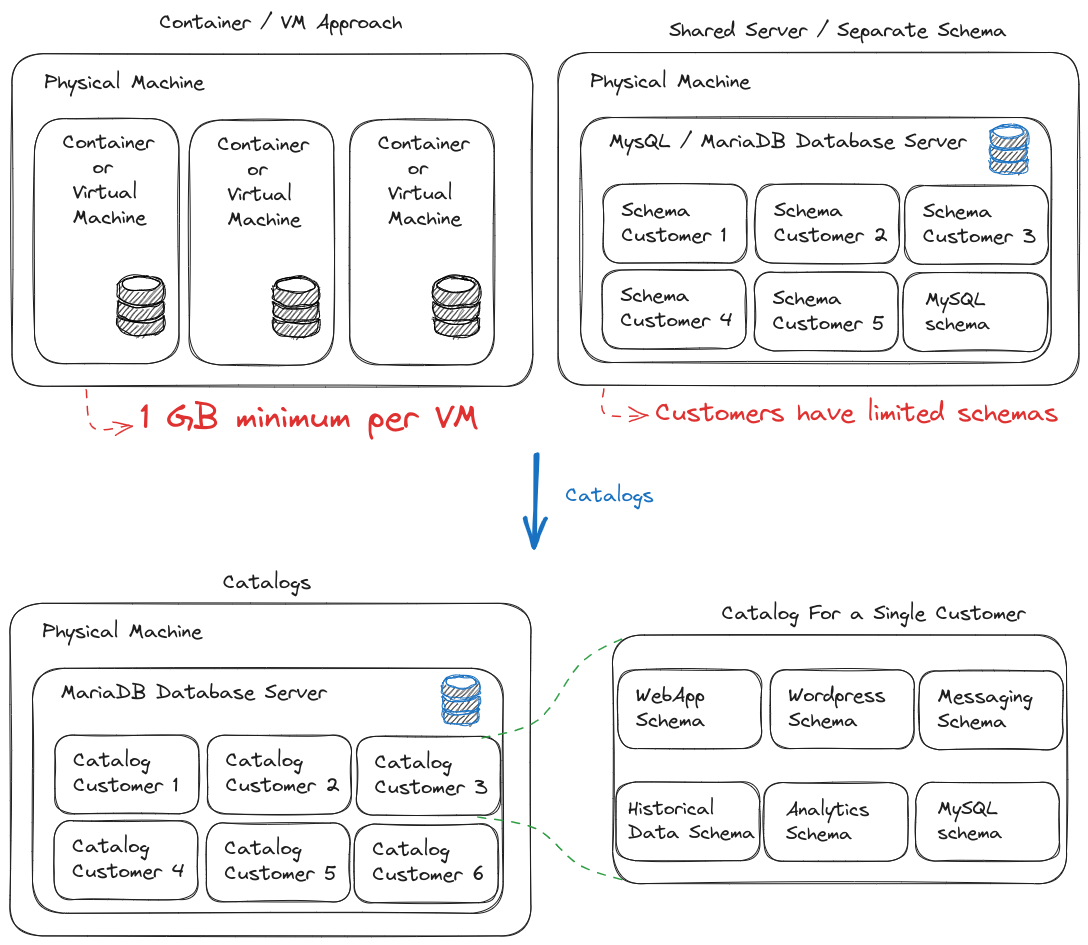
We’ve made significant progress on MariaDB Catalogs, and while there’s still work to be done, we’re excited to offer the community an easy way to try out our preview release. You no longer need to compile the source code yourself—just use our prebuilt containers, now available on our official quay.io development registry.
The code is available publicly on Github, in a separate repo compared to the official MariaDB Server (until the feature gets published as part of an official MariaDB Server release)
Documentation is available on the Knowledge Base.
…
Continue reading “MariaDB Catalogs preview containers available”

The MariaDB Foundation is pleased to announce the availability of MariaDB 11.8.1, the Release Candidate (RC) in the long-term MariaDB 11.8 release, and MariaDB 11.7.2, the latest Generally Available (GA) rolling release.
See the release notes and changelogs for details, as well as the MariaDB 11.8.LTS announcement.
Release Notes Changelog What is MariaDB 11.8?
Release Notes Changelog What is MariaDB 11.7?
…
Continue reading “MariaDB 11.7.2 and MariaDB 11.8.1 now available”
The MariaDB Foundation is pleased to announce the availability of MariaDB 11.4.5, MariaDB 10.11.11, MariaDB 10.6.21 and MariaDB 10.5.28, the latest stable releases in their respective long-term series (maintained for five years from their first stable release dates).
See the release notes and changelogs for details.
Release Notes Changelog What is MariaDB 11.4?
Release Notes Changelog What is MariaDB 10.11?
…
Continue reading “MariaDB 11.4.5, 10.11.11, 10.6.21 and 10.5.28 now available”

The MariaDB Foundation is pleased to announce the availability of MariaDB 11.7.1, the latest rolling release Release Candidate (RC), and MariaDB 11.6.2, the latest Generally Available (GA) rolling release.
A subset of the new features in MariaDB 11.7 include:
- Vectors
- Optimizer improvements (including the Charset Narrowing Optimization being on by default)
- Functions for generating version 4 and version 7 UUIDs
- The ROW data type as a return value in stored procedures
See the release notes and changelogs for details. …
Continue reading “MariaDB 11.6.2 and MariaDB 11.7.1 now available”
The MariaDB Foundation is pleased to announce the availability of MariaDB 11.4.4, MariaDB 10.11.10, MariaDB 10.6.20 and MariaDB 10.5.27, the latest stable releases in their respective long-term series (maintained for five years from their first stable release dates), as well as MariaDB 11.2.6 the latest and final scheduled release in the 11.2 short-term series (maintained for one year)
See the release notes and changelogs for details.
Release Notes Changelog What is MariaDB 11.4?
…
Continue reading “MariaDB 11.4.4, 11.2.6, 10.11.10, 10.6.20 and 10.5.27 now available”

The MariaDB Foundation is pleased to announce the availability of MariaDB 11.7.0, a preview of the MariaDB 11.7 series. MariaDB 11.7 will be a rolling release.
MariaDB 11.7.0 introduces numerous new features, in particular
* Functions to generate UUID version 4 and version 7. A contribution by Stefano Petrilli.
* Near-instant binlogging of large transactions (avoid copying into the binary log). A contribution by Song Libing.
* Faster crash recovery where prepared transactions are rolled back asynchronously. A contribution by Song Libing.
* Cost-based choice between subquery optimization strategies in UPDATE and DELETE
* New GIS functions: ST_Validate(), MBRCoveredBy(), ST_Simplify(), ST_GeoHash(), ST_LatFromGeoHash(), ST_LongFromGeoHash(), ST_IsValid(), ST_Collect(). …